
In today’s competitive digital landscape, online visibility is an opportunity you cannot afford to miss. Most users rely on search engines to find products, services, information, and solutions. If your website does not appear where your potential customers are searching, you may be losing valuable traffic and business opportunities.
Ranking on Google is no longer just about adding a few keywords to a webpage. A successful SEO strategy in 2026 requires a combination of high-quality content, technical optimization, user experience, authority, and a clear understanding of search intent.
For businesses looking to grow online, a strong SEO marketing strategy can help attract the right audience, build trust, increase website traffic, and generate more leads and conversions.
Let’s explore what an SEO marketing strategy is and the seven essential elements that can help your business succeed in search in 2026.
What Is an SEO Marketing Strategy?
An SEO marketing strategy is a planned approach to improving a website’s visibility in search engine results. The goal is to help your website appear when people search for relevant keywords, products, services, or information.
A successful SEO strategy focuses on more than rankings. It should help you:
- Increase organic website traffic
- Reach the right target audience
- Improve brand visibility
- Build trust and authority
- Generate quality leads
- Increase conversions and sales
- Create long-term online growth
At EasyZoneHub, we believe that effective digital growth starts with the right strategy. SEO is not a one-time task—it is an ongoing process of optimizing, improving, analyzing, and adapting.
1. Start With Smart Keyword Research
Keyword research is the foundation of every successful SEO strategy.
Before creating content, you need to understand what your audience is searching for. Instead of targeting random keywords, focus on search terms that are relevant to your business and match the user’s intent.
For example, users may search for:
- Best digital marketing services
- SEO services for small businesses
- How to improve Google rankings
- Website design and SEO services
- Digital marketing strategy for business growth
A good keyword strategy should include a mix of:
Short-tail keywords: Broad and highly competitive search terms.
Long-tail keywords: More specific phrases that often attract highly targeted visitors.
Informational keywords: Searches from users looking for answers or knowledge.
Commercial keywords: Searches from users comparing products or services.
Transactional keywords: Searches from users who are ready to take action.
The goal is not simply to get more traffic. The goal is to attract the right traffic.
2. Create High-Quality, Helpful Content
Content remains one of the most important parts of SEO.
Search engines aim to provide users with useful and relevant information. This means your content should genuinely answer questions, solve problems, and provide value.
Instead of creating content only for search engines, create content for real people.
A strong content strategy may include:
- Blog posts
- Service pages
- How-to guides
- FAQs
- Case studies
- Industry updates
- Tutorials
- Product or service comparisons
Every piece of content should have a clear purpose.
Ask yourself:
What problem is this content solving?
What question is the user asking?
Why should someone trust this information?
When your content provides real value, users are more likely to stay on your website, explore additional pages, and return in the future.
3. Focus on Search Intent
Understanding search intent is essential for SEO success.
A keyword alone does not tell the complete story. You also need to understand why someone is searching for that keyword.
Generally, search intent can be divided into four categories:
Informational Intent
The user wants to learn something.
Example:
“How does SEO work?”
Navigational Intent
The user wants to find a specific website or brand.
Example:
“EasyZoneHub digital marketing services”
Commercial Intent
The user is researching before making a decision.
Example:
“Best SEO agency for small businesses”
Transactional Intent
The user is ready to take action.
Example:
“Hire an SEO expert”
Your content should match the intent behind the search. If a user wants information, provide a helpful guide. If they are ready to purchase a service, make it easy for them to contact you or take the next step.
4. Improve Your Website’s Technical SEO
Great content may struggle to perform if your website has technical problems.
Technical SEO helps search engines discover, understand, and properly index your website.
Important areas to focus on include:
- Website loading speed
- Mobile responsiveness
- Secure HTTPS connection
- Clean website structure
- XML sitemap
- Proper indexing
- Internal linking
- Fixing broken links
- Optimized URLs
- Structured data where relevant
Your website should also provide a smooth experience across mobile, tablet, and desktop devices.
A fast, well-organized, and user-friendly website creates a better experience for visitors and makes it easier for search engines to understand your content.
5. Build Authority and Trust
Authority plays an important role in long-term SEO success.
Search engines and users are more likely to trust websites that demonstrate expertise and provide reliable information.
You can build authority by:
- Publishing original and useful content
- Updating outdated information
- Earning quality backlinks
- Creating detailed guides
- Showcasing your expertise
- Adding clear business information
- Maintaining accurate contact details
- Building a strong brand presence
Avoid focusing only on the number of backlinks. Quality and relevance are more important than simply collecting links.
A strong online reputation can support both search visibility and customer trust.
6. Optimize for User Experience and Conversions
Getting visitors to your website is only the first step.
Once users arrive, your website should make it easy for them to find information and take action.
A good user experience includes:
- Easy navigation
- Clear headings
- Readable content
- Fast-loading pages
- Mobile-friendly design
- Clear call-to-action buttons
- Simple contact forms
- Relevant internal links
For example, after reading a blog about SEO, users could be guided toward a relevant service page or encouraged to contact your team.
Your SEO strategy should connect traffic with business goals.
More visitors are valuable, but relevant visitors who take action are even more valuable.
7. Monitor, Analyze, and Continuously Improve
SEO is not a “set it and forget it” strategy.
Search trends change, competitors publish new content, technology evolves, and user behavior changes over time.
That is why regular monitoring is essential.
Track important metrics such as:
- Organic traffic
- Keyword visibility
- Click-through rate
- User engagement
- Conversion rate
- Top-performing pages
- Pages losing traffic
- Technical website issues
Use this information to identify opportunities for improvement.
For example, you may discover that an older blog needs updated information, a service page needs stronger calls to action, or a high-performing keyword deserves a more detailed content strategy.
Continuous optimization helps your SEO strategy remain competitive.
Why SEO Matters for Business Growth
SEO can be one of the most valuable long-term digital marketing strategies for businesses.
Unlike paid advertising, organic visibility can continue to bring relevant traffic over time when you consistently create valuable content and maintain a well-optimized website.
A strong SEO strategy can help your business:
- Reach potential customers organically
- Increase brand awareness
- Build trust with your audience
- Generate consistent website traffic
- Support long-term digital growth
- Improve lead generation
- Create a stronger online presence
The key is consistency.
SEO success rarely happens overnight. Businesses that invest in quality content, technical improvements, user experience, and continuous optimization are better positioned for sustainable growth.
Build Your SEO Strategy With EasyZoneHub
The digital world is becoming increasingly competitive, but the right strategy can help your business stand out.
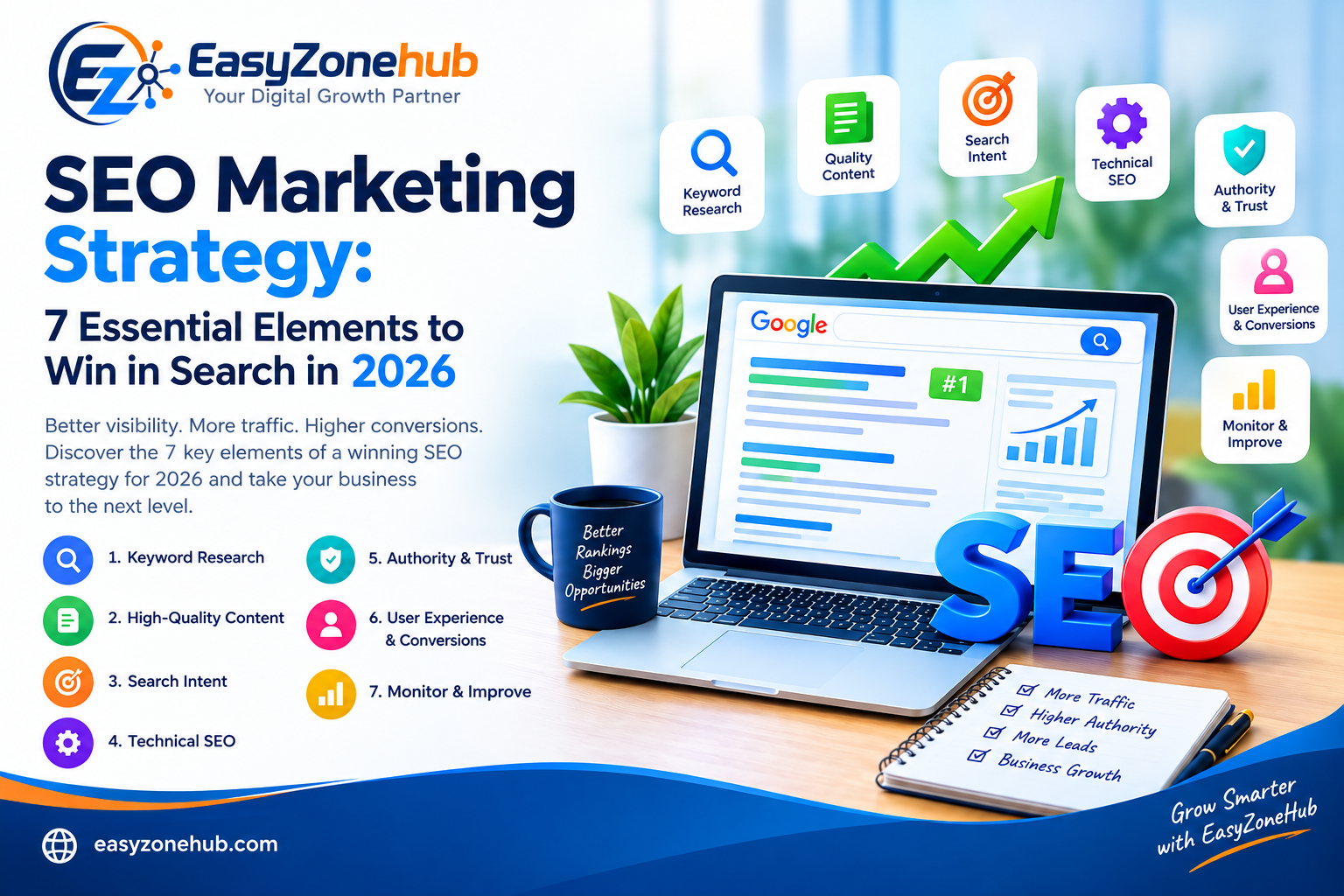
A successful SEO marketing strategy in 2026 should focus on more than rankings. It should combine keyword research, valuable content, search intent, technical SEO, authority, user experience, and continuous improvement.
At EasyZoneHub, we focus on helping businesses build a stronger online presence through effective digital solutions and smart marketing strategies.
Whether you are building a new website, improving your existing online presence, or looking for ways to attract more visitors, a well-planned SEO strategy can help create long-term growth.
Final Thoughts
SEO is not about chasing shortcuts or trying to rank for every keyword.
The most successful strategy is to understand your audience, create useful content, provide a great website experience, and continuously improve your online presence.
Start with a clear plan, focus on providing real value, and build your SEO strategy for long-term success.
Ready to grow your online presence? Explore more digital marketing insights, website solutions, and business growth strategies with EasyZoneHub.