
In today’s competitive digital landscape, businesses of all sizes need to continuously improve their branding and online marketing strategies. Whether you are repositioning your brand, launching a new campaign, or trying to reach a new audience, a strong SEO and digital marketing strategy can help your business build visibility and attract potential customers.
Over the past few years, digital marketing has become an essential part of business growth. As competition increases, simply having a website is no longer enough. Businesses need to create useful content, understand their target audience, optimize their websites, and develop strategies that can generate consistent organic traffic.
If you are looking for practical ways to increase organic traffic and strengthen your online presence, this guide from EasyZoneHub will help you get started.
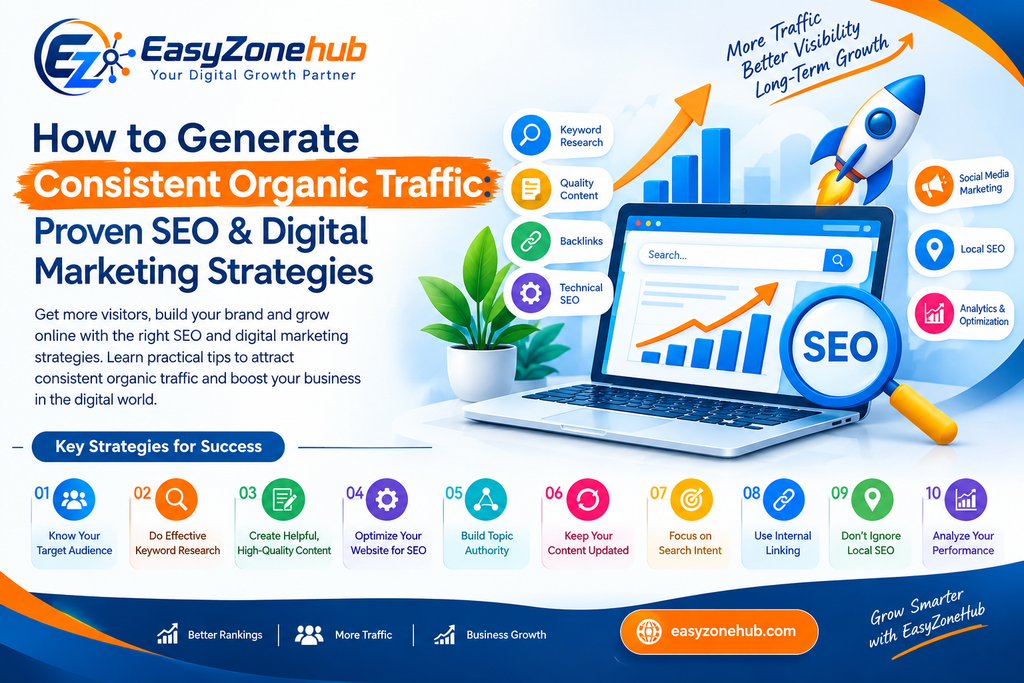
Tips for Generating Consistent Organic Traffic
Knowing your target audience and identifying both short-term and long-term marketing goals are important first steps. Once these are clear, businesses can develop a consistent digital marketing plan using simple but effective strategies.
Let’s explore some of the most useful ways to generate organic traffic.
1. Understand Your Target Audience
Before creating content, understand who you are trying to reach.
Research your audience’s:
- Interests and preferences
- Problems and requirements
- Search behavior
- Frequently asked questions
- Buying behavior
- Preferred social media platforms
When you understand what your audience is searching for, you can create content that directly addresses their needs.
The right audience + the right content = better opportunities for organic growth.
2. Perform Effective Keyword Research
Keyword research remains an important part of SEO.
Find keywords that your potential customers actually use when searching for products, services, or information related to your business.
Focus on a combination of:
- Primary keywords
- Long-tail keywords
- Question-based keywords
- Local keywords
- Informational search terms
- Commercial search terms
Instead of targeting only highly competitive keywords, consider using specific long-tail keywords that closely match your audience’s search intent.
3. Create Helpful, High-Quality Content
Content is one of the most important assets for generating organic traffic.
Create articles, guides, FAQs, videos, and other resources that genuinely help your audience.
For example, if your business provides digital marketing services, you could create content around:
- SEO tips for beginners
- Social media marketing strategies
- Google search updates
- Content marketing
- Local SEO
- AI and digital marketing
- Website optimization
Avoid creating content simply to insert keywords. Create content to solve problems.
4. Optimize Your Website for SEO
A technically strong website provides a better foundation for organic growth.
Pay attention to important SEO elements such as:
- Page titles
- Meta descriptions
- Heading structure
- URL structure
- Internal linking
- Image optimization
- Mobile responsiveness
- Website speed
- Crawlability and indexing
A website should be easy for both users and search engines to understand.
5. Build Topic Authority
Publishing one article about a subject may not be enough to establish your website as a valuable resource.
Instead, create multiple pieces of content around related topics.
For example, your main topic could be SEO Marketing. Supporting articles could cover:
Keyword Research → On-Page SEO → Technical SEO → Link Building → Local SEO → Content Strategy → SEO Analytics
Connect these articles using relevant internal links.
This creates a stronger content structure and helps visitors discover more useful information.
6. Keep Your Content Updated
SEO is not a one-time activity.
Digital marketing trends, search behavior, tools, and best practices continue to change. Review your older content regularly and update information where necessary.
You can improve an existing article by:
- Adding new information
- Updating statistics
- Improving headings
- Adding FAQs
- Removing outdated information
- Adding relevant internal links
- Improving readability
Fresh and useful content can provide greater long-term value to your audience.
7. Focus on Search Intent
Understanding search intent is essential for successful SEO.
Ask yourself what the user actually wants when they search for something.
Search intent can generally include:
- Informational: Looking for information
- Navigational: Looking for a specific website or brand
- Commercial: Comparing products or services
- Transactional: Ready to take an action or make a purchase
Your content should satisfy the intent behind the search rather than simply matching a keyword.
8. Use Internal Linking Strategically
Internal links connect one page of your website to another.
For example, an article about organic traffic can link to your related articles about SEO, social media marketing, content marketing, and digital marketing.
Internal linking can help:
- Visitors discover related content
- Improve website navigation
- Distribute authority between pages
- Create a logical content structure
Use descriptive and relevant anchor text rather than random phrases.
9. Don’t Ignore Local SEO
If your business serves a specific city or geographical area, local SEO can be extremely valuable.
Optimize your online presence around relevant local searches and ensure your business information is accurate and consistent.
Create useful location-specific content where appropriate, such as:
“Digital Marketing Services in [City]”
or
“Best SEO Strategies for Local Businesses”
This can help businesses connect with audiences who are searching for services in their area.
10. Analyze Your SEO Performance
You cannot improve what you do not measure.
Regularly monitor important metrics such as:
- Organic traffic
- Search impressions
- Keyword performance
- Click-through rate
- Conversion rate
- Engagement
- Top-performing pages
- Traffic sources
Use these insights to identify what is working and where improvements are needed.
How EasyZoneHub Can Help
At EasyZoneHub, we believe that sustainable online growth comes from combining SEO, content, social media, and smart digital marketing strategies.
Instead of relying on a single technique, businesses should build a complete digital strategy focused on visibility, useful content, audience engagement, and conversions.
Whether you are starting a new website or trying to improve an existing online presence, a consistent approach can help create better opportunities for long-term growth.
Final Thoughts
Generating consistent organic traffic takes time, patience, and strategic planning. There is no single SEO technique that guarantees success overnight.
The key is to understand your audience, create valuable content, optimize your website, target relevant search intent, build authority, and continuously analyze your results.
Don’t just aim for more traffic—aim for the right traffic.
With the right SEO and digital marketing strategy, organic traffic can become a sustainable source of visibility, leads, and business growth.
🚀 Grow Your Online Presence with EasyZoneHub
Stay connected with EasyZoneHub for practical SEO tips, digital marketing strategies, social media updates, AI marketing trends, and useful insights to help your business grow online.