
The digital world is evolving faster than ever. For businesses, marketers, and website owners, one reality is becoming clear: evolve or risk becoming invisible.
For years, traditional Search Engine Optimization (SEO) has been the foundation of online visibility. Businesses focused on ranking higher on search engines, attracting organic traffic, and reaching potential customers through platforms like Google and Bing.
But search is changing.
Artificial intelligence is transforming how people discover information online. Instead of simply browsing through a list of blue links, users are increasingly asking AI-powered platforms direct questions and receiving complete, conversational answers.
This shift has introduced a new approach to digital visibility: Generative Engine Optimization (GEO).
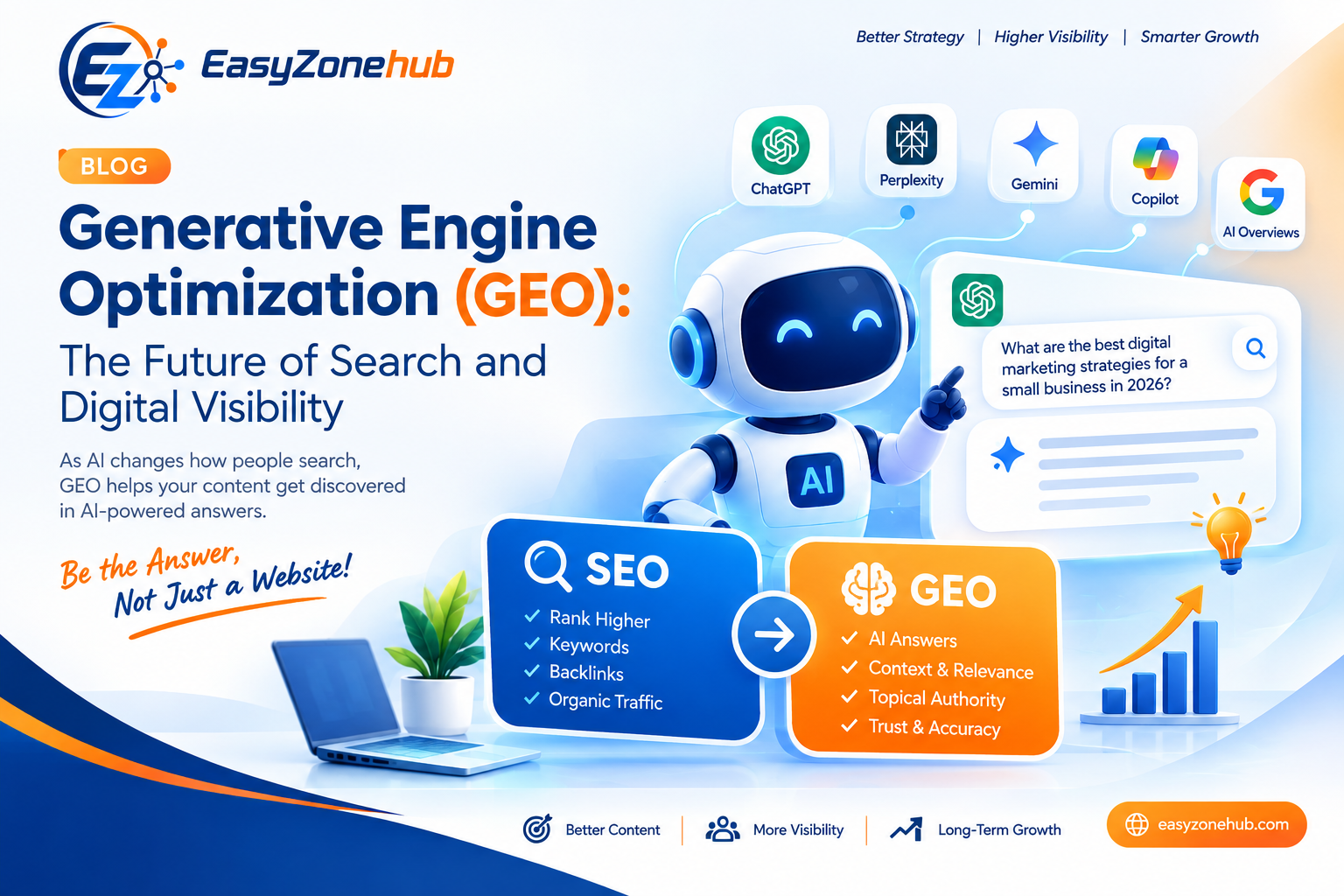
What Is Generative Engine Optimization (GEO)?
Generative Engine Optimization, commonly known as GEO, is the process of optimizing digital content so that it can be understood, selected, referenced, and potentially recommended by AI-powered search and answer engines.
Traditional SEO mainly focuses on improving rankings in search engine results pages. GEO, on the other hand, focuses on making your content valuable and understandable for AI systems that generate answers.
AI-powered platforms such as ChatGPT, Perplexity, Gemini, Copilot, and Google’s AI-powered search experiences are changing the way users find information.
Instead of searching:
“Best digital marketing strategies”
A user may ask:
“What are the best digital marketing strategies for a small business in 2026?”
The AI system may then analyze information from multiple relevant sources and generate a direct answer.
The question for businesses is simple:
Will your content be part of that answer?
SEO vs GEO: What Is the Difference?
SEO and GEO are connected, but they focus on different types of visibility.
Traditional SEO Focuses On:
- Ranking higher in search results
- Keywords and search intent
- Backlinks and website authority
- Technical SEO
- Organic traffic
- Click-through rates
GEO Focuses On:
- Being useful in AI-generated answers
- Clear and structured information
- Topical authority
- Context and relevance
- Trustworthy and accurate content
- Answering specific user questions
In simple terms:
SEO helps people find your website.
GEO helps AI systems understand why your website should be included in an answer.
The strongest digital strategy is not choosing SEO or GEO.
It is combining SEO + GEO.
Why GEO Is Important for Businesses
The way people search for information is changing.
Users increasingly prefer conversational searches where they can ask complete questions, request recommendations, compare options, and receive personalized answers.
This creates both an opportunity and a challenge for businesses.
If your website provides clear, useful, authoritative, and well-structured information, AI systems may find it easier to understand your content.
However, if your content is outdated, thin, poorly structured, or provides little real value, your brand may struggle to remain visible as search behavior evolves.
For modern businesses, GEO is becoming an important part of building long-term digital visibility.
How AI-Powered Search Changes Content Strategy
AI search engines do not simply look for pages containing a specific keyword.
They aim to understand:
- What the user is actually asking
- The context behind the question
- Which information is most relevant
- Which sources appear trustworthy
- How different pieces of information connect
This means content creators need to move beyond simply repeating keywords.
The future of content is about clarity, expertise, context, and usefulness.
For example, instead of creating a page that only targets:
“Best SEO Tips”
A stronger content strategy may answer multiple related questions:
- What is SEO?
- Why is SEO important?
- How does SEO work?
- What are the best SEO strategies?
- How can beginners improve their website rankings?
- What SEO mistakes should businesses avoid?
This approach creates deeper topical coverage and provides more useful information for both users and AI systems.
Key Strategies for Generative Engine Optimization
1. Create High-Quality and Helpful Content
The foundation of GEO is useful content.
Your content should solve real problems and answer genuine questions from your audience.
Avoid creating content only to target keywords. Instead, focus on providing practical, accurate, and valuable information.
Ask yourself:
“If an AI assistant were answering this question, would my content provide enough useful information to support that answer?”
If the answer is yes, you are moving in the right direction.
2. Use Clear Content Structure
AI systems and users both benefit from well-organized content.
Use:
- Clear headings
- Short paragraphs
- Bullet points
- Frequently asked questions
- Step-by-step explanations
- Tables where appropriate
- Simple and direct language
A well-structured article makes it easier for readers to scan information and helps search technologies understand the relationship between different topics.
3. Focus on User Questions
Modern search is becoming more conversational.
People are no longer searching only with short keywords. They are asking complete questions.
Your content should address these questions directly.
For example:
Instead of only targeting:
“Digital Marketing Services”
Create content that answers questions such as:
- What digital marketing services does a small business need?
- How much does digital marketing cost?
- Which digital marketing strategy delivers the best results?
- How long does digital marketing take to show results?
Question-focused content can provide valuable opportunities for both traditional search visibility and AI-powered discovery.
4. Build Topical Authority
Publishing one article about a topic is often not enough.
To build authority, create a collection of valuable content around related subjects.
For example, a digital marketing website could create content about:
- SEO
- Local SEO
- Content marketing
- Social media marketing
- Google Ads
- Email marketing
- AI marketing tools
- Generative Engine Optimization
When these topics are covered in depth and connected logically, your website can demonstrate stronger expertise within its niche.
5. Keep Your Information Accurate and Updated
AI-powered systems depend on quality information.
Regularly review your content to ensure that statistics, strategies, tools, and recommendations remain relevant.
Outdated information can reduce the long-term value of your content.
Updating existing content can be just as important as creating new articles.
How EasyZoneHub Can Prepare for the GEO Era
At EasyZoneHub, we believe that the future of digital growth requires businesses to adapt to changing technologies.
As AI continues to influence search behavior, businesses need content strategies that go beyond traditional keyword optimization.
A future-ready digital strategy should focus on:
- High-quality website content
- Search engine optimization
- AI-friendly content structure
- Clear answers to user questions
- Strong topical authority
- Regular content updates
- Helpful and trustworthy information
The goal is simple:
Create content that people trust, search engines understand, and AI systems can confidently use as a valuable source of information.
The Future of SEO and GEO
GEO is not necessarily replacing SEO.
Instead, it represents the next evolution of search optimization.
Search engines, AI assistants, answer engines, and generative search experiences are increasingly becoming part of the same digital ecosystem.
Businesses that continue to focus only on traditional rankings may miss new opportunities for visibility.
The future belongs to brands that create content for the way people actually search.
That means understanding:
Keywords + Search Intent + User Experience + AI Understanding + Content Authority.
By combining traditional SEO with Generative Engine Optimization, businesses can create a stronger and more sustainable online presence.
Final Thoughts
The search landscape is changing, and AI is becoming an important part of how people discover information, products, services, and businesses.
Generative Engine Optimization represents an opportunity for brands to prepare for this new era of search.
The key is not to chase every new technology.
The key is to create genuinely helpful, accurate, well-structured, and authoritative content.
At EasyZoneHub, our focus is on helping businesses understand the changing digital landscape and discover smarter strategies for online growth.
The future of search is not just about ranking higher.
It is about becoming the answer.