
Content plays a crucial role in today’s digital landscape. Whether you run a small business, startup, or large enterprise, high-quality content is one of the most effective ways to connect with your target audience.
But creating content is no longer just about publishing articles regularly. Search engines and users increasingly expect content to be helpful, relevant, well-structured, accurate, and engaging.
This is where AI Content Optimization comes into the picture.
Artificial intelligence is changing the way businesses research topics, create content, optimize websites, understand audiences, and improve their digital marketing strategies. With the right approach, AI can help content teams work faster while maintaining quality and relevance.
In this guide, EasyZoneHub explains AI content optimization, how it works, its benefits, and practical ways businesses can use it to improve their content strategy.
What Is AI Content Optimization?
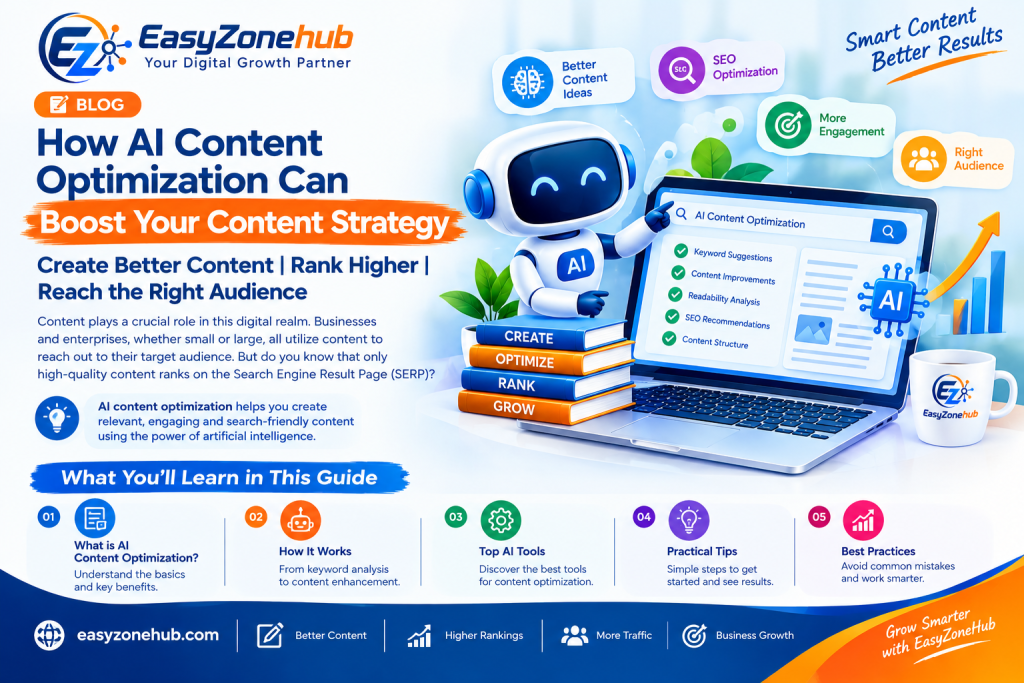
AI Content Optimization is the process of using artificial intelligence and machine-learning-powered tools to analyze, improve, and optimize content for both users and search engines.
AI can help content creators identify opportunities to improve:
- Content relevance
- Keyword usage
- Search intent
- Readability
- Content structure
- Topic coverage
- Headlines and titles
- Internal linking
- Audience engagement
- SEO performance
Instead of replacing the content creator, AI can work as a smart assistant throughout the content creation and optimization process.
The goal should not be to publish AI-generated content without review. Instead, businesses can use AI to make the overall content workflow more efficient while keeping human expertise, originality, accuracy, and brand voice at the center.
Why Is AI Content Optimization Important?
The amount of content published online is growing rapidly. As a result, businesses need to create content that stands out and provides genuine value.
AI can help marketers analyze large amounts of information and identify patterns that may be difficult to discover manually.
For example, AI-powered tools can help you understand:
- What your audience is searching for
- Which topics are related to your main subject
- What questions users commonly ask
- How readable your content is
- Which sections need improvement
- What content gaps you may have
This information can help businesses build a more strategic content plan.
How AI Can Improve Your Content Strategy
1. Discover Better Content Ideas
Coming up with fresh content ideas consistently can be challenging.
AI tools can help generate topic ideas based on your industry, audience, and existing content.
For example, a digital marketing website can explore topics such as:
- Latest SEO trends
- AI marketing tools
- Social media strategies
- Content marketing tips
- Local SEO
- Search engine updates
- Digital marketing strategies
However, every AI-generated idea should be checked against your audience’s actual needs and search intent.
2. Improve Keyword Research
Keywords continue to play an important role in SEO, but modern content strategies should focus on topics and search intent, rather than keyword repetition.
AI can help identify:
- Primary keywords
- Related keywords
- Long-tail keywords
- Question-based searches
- Related topics
- Search-intent patterns
This can help content writers create more comprehensive articles that naturally cover the subject.
Tip: Never force keywords into your content. Write naturally for the reader first.
3. Optimize Content for Search Intent
One of the most important aspects of modern SEO is understanding what users actually want.
For example, someone searching for:
“How to improve SEO”
is probably looking for educational information.
Someone searching for:
“SEO services near me”
may have a commercial or transactional intent.
AI can help analyze search queries and categorize their likely intent, allowing marketers to create content that better matches what users are looking for.
4. Improve Content Readability
Even valuable information can fail to engage readers if it is difficult to understand.
AI tools can help identify:
- Long sentences
- Complex wording
- Repeated phrases
- Passive writing
- Poor paragraph structure
- Difficult-to-read sections
Breaking large blocks of text into shorter paragraphs, headings, bullet points, and examples can make your content easier to consume.
5. Create Better Content Structures
Before writing an article, AI can help create a logical outline.
A good structure might include:
Introduction → Main Topic → Key Strategies → Examples → Common Mistakes → FAQs → Conclusion
This gives readers a clear path through the article.
It also helps content creators avoid missing important subtopics.
6. Find Content Gaps
Content gap analysis helps identify information that your existing content may be missing.
For example, if you have an article about SEO Marketing, AI-assisted analysis may suggest related areas such as:
- Technical SEO
- On-page SEO
- Link building
- Local SEO
- Search intent
- Core web performance
- SEO analytics
Adding genuinely useful sections can make your content more comprehensive.
7. Optimize Existing Content
AI content optimization isn’t only useful for new articles.
Your existing blog posts may contain valuable information but still need improvement.
You can review older articles and update:
- Outdated information
- Titles
- Headings
- Meta descriptions
- Internal links
- FAQs
- Examples
- Content structure
- Readability
Regular content updates can help maintain the usefulness and relevance of your website.
AI Content Optimization Workflow
A simple AI-assisted content workflow can look like this:
Step 1: Research
Understand your audience, topic, competitors, and search intent.
Step 2: Generate Ideas
Use AI to brainstorm relevant topics and questions.
Step 3: Create an Outline
Organize the article into logical sections.
Step 4: Write the Content
Create original content using your expertise and brand voice.
Step 5: Optimize
Use AI tools to check readability, topic coverage, keywords, and structure.
Step 6: Human Review
Fact-check the information, remove unnecessary content, and add your own insights.
Step 7: Publish
Optimize the page title, description, images, links, and other SEO elements before publishing.
Step 8: Monitor Performance
Track traffic, rankings, engagement, and conversions and improve the content over time.
Benefits of AI Content Optimization
When used correctly, AI can provide several benefits to content teams.
⚡ Faster Content Workflow
AI can reduce the time required for brainstorming, research assistance, outlining, and editing.
🎯 Better Relevance
AI-assisted analysis can help you create content that closely matches audience interests and search intent.
📈 Improved SEO Strategy
AI can help identify keywords, related topics, content gaps, and optimization opportunities.
👥 Better Audience Targeting
Understanding audience questions and behavior can help businesses deliver more relevant content.
🔄 Easier Content Updates
AI can assist in identifying older pages that may benefit from review and improvement.
Best Practices for AI Content Optimization
AI is powerful, but it should be used responsibly.
Keep these best practices in mind:
1. Keep Humans in the Loop
Always review AI-assisted content before publishing.
2. Prioritize Accuracy
Fact-check important claims, statistics, and recommendations.
3. Add Original Insights
Your experience, examples, expertise, and unique perspective can make content more valuable.
4. Don’t Overuse Keywords
Write naturally instead of trying to manipulate search rankings.
5. Focus on Readers
Search optimization should never come at the expense of user experience.
6. Maintain Your Brand Voice
AI-generated suggestions should be adapted to match your business’s tone and communication style.
AI Content Optimization vs Traditional Content Optimization
| Traditional Approach | AI-Assisted Approach |
|---|---|
| Manual research | AI-assisted research |
| Manual topic discovery | AI-supported topic ideas |
| Manual content analysis | Automated content analysis |
| Manual readability checks | AI readability suggestions |
| Manual content-gap research | AI-assisted gap identification |
| Manual optimization | AI-assisted optimization |
| Human decision-making | Human + AI collaboration |
The best approach is not AI versus humans.
It is AI + human expertise.
The Future of AI Content Optimization
AI is becoming an important part of the digital marketing ecosystem. As search engines and AI-powered answer platforms continue to evolve, businesses will need content that is useful, trustworthy, well-organized, and genuinely valuable.
Successful content strategies will increasingly combine:
Human Expertise + AI Assistance + SEO + Search Intent + Quality Content
Businesses that learn how to use AI strategically can improve their content workflow while continuing to focus on quality and audience value.
Final Thoughts
AI Content Optimization is changing the way businesses approach content marketing.
From discovering topics and analyzing keywords to improving readability and updating existing articles, AI can support almost every stage of the content workflow.
However, AI should be treated as a tool—not a replacement for human creativity and expertise.
The strongest content is content that answers real questions, provides useful information, demonstrates expertise, and gives readers a reason to trust your brand.
At EasyZoneHub, our goal is to help businesses understand SEO, AI, social media, and digital marketing strategies so they can build a stronger online presence.
🚀 Create Smarter Content. Reach the Right Audience. Grow Online.
Follow EasyZoneHub for more SEO updates, AI marketing tips, content strategies, and digital marketing insights.